CMMC Level 2 Compliance for Small Businesses: The Definitive Guide

The Department of Defense (DoD) has drawn a hard, unforgiving line in the sand: cybersecurity is no longer an optional "best practice" in federal procurement. It is a mandatory, legally binding barrier to entry.
With the formal, highly anticipated rollout of the Cybersecurity Maturity Model Certification (CMMC), the era of self-attestation is effectively over. If your small business operates anywhere within the Defense Industrial Base (DIB)—whether as a massive prime contractor or a deeply embedded sub-tier supplier—and you handle Controlled Unclassified Information (CUI), you will be strictly required to achieve CMMC Level 2 compliance.
Failing to achieve this certification means your firm will be legally barred from bidding on, or performing work under, any DoD contract containing the DFARS 252.204-7021 clause. For tens of thousands of defense contractors, CMMC is not just an IT hurdle; it is an existential business requirement.
In this definitive 2026 guide, we demystify the complexities of CMMC Level 2, break down the specific control families of NIST SP 800-171, and provide a realistic, budget-conscious roadmap for small businesses to achieve audit readiness without bankrupting their operations.
Table of Contents
- 01.What Exactly is CMMC Level 2?
- 02.Who Needs CMMC Level 2 Compliance?
- 03.The 14 Security Control Families of NIST SP 800-171
- 04.The C3PAO Assessment Process
- 05.A Step-by-Step Road to Audit Readiness
- 06.Conclusion: Security as a Competitive Advantage
- 07.Frequently Asked Questions (FAQ)
- 08.Related InfiniSolve Insights
What Exactly is CMMC Level 2?
CMMC Level 2 is specifically designed to protect Controlled Unclassified Information (CUI) from state-sponsored cyber espionage. CUI is sensitive, unclassified data created or possessed by the government (or an entity acting on behalf of the government) that requires strict safeguarding or dissemination controls.
Common examples of CUI in the GovCon space include: - Technical engineering drawings and proprietary schematics for defense systems. - Unclassified proprietary weapons systems data and software source code. - Specific contract pricing data, supplier lists, and logistical schedules. - Personally Identifiable Information (PII) of government and military personnel.
CMMC Level 2 is in perfect, 1-to-1 alignment with NIST SP 800-171 Rev 2, the foundational cybersecurity standard that outlines security requirements for protecting CUI in non-federal systems. To achieve CMMC Level 2, your organization must fully and verifiably implement all 110 security controls spread across 14 distinct security domains.
Who Needs CMMC Level 2 Compliance?
If you are currently executing a DoD contract that contains the older DFARS 252.204-7012 clause, you are already legally obligated to protect CUI. Under this older clause, you were allowed to self-attest your compliance and upload a score to the Supplier Performance Risk System (SPRS). CMMC Level 2 transforms this highly flawed honors-system self-attestation into a rigorously audited, third-party verification process.
You will definitively need CMMC Level 2 if: - Your firm directly receives, stores, processes, or transmits CUI under a DoD contract. - You are a subcontractor to a larger prime contractor (like Lockheed Martin, General Dynamics, or Raytheon) who formally flows down CUI requirements to your systems. - You are actively pursuing new solicitations that contain specific CMMC cybersecurity set-asides or prerequisites.
*Note: If your firm only handles basic Federal Contract Information (FCI) and zero CUI, you only need CMMC Level 1, which requires a much simpler set of 17 foundational security practices. However, most technology, engineering, and manufacturing contractors will fall strictly under Level 2.*
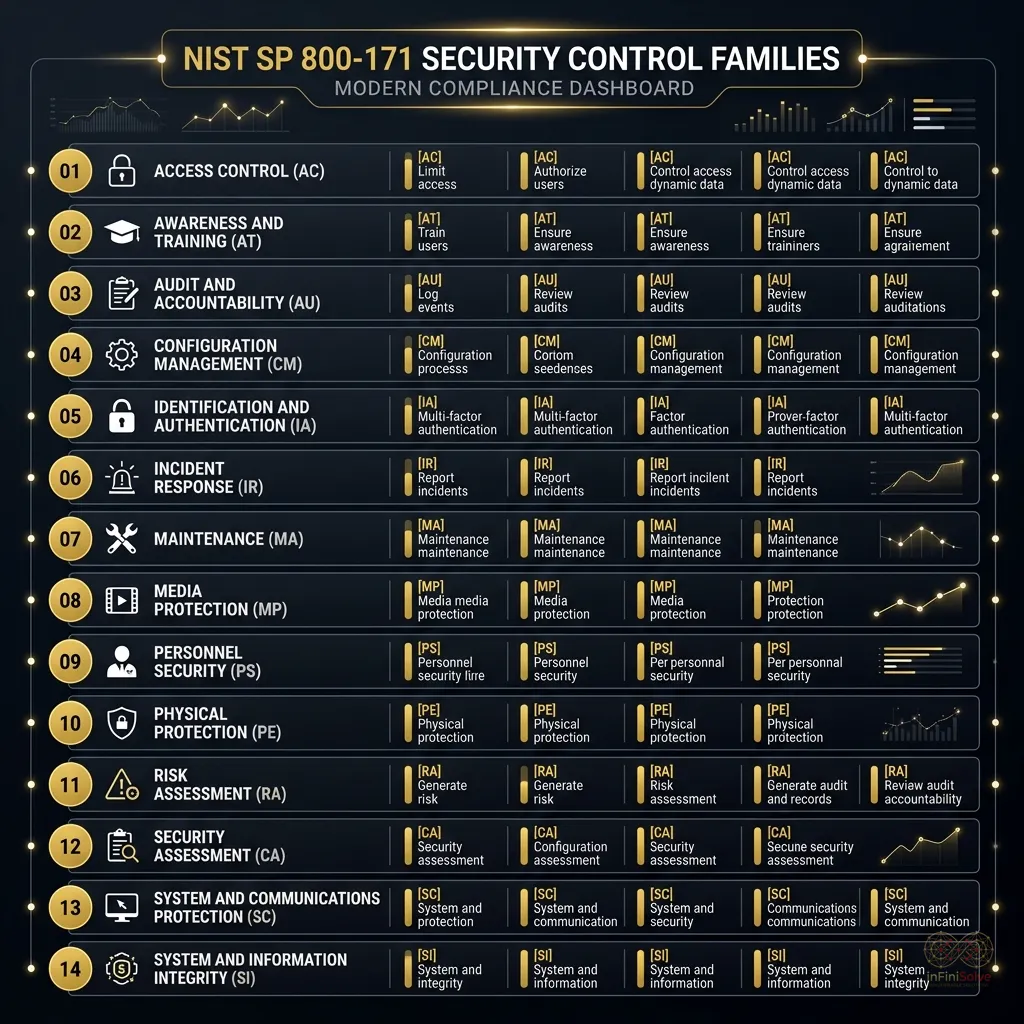
The 14 Security Control Families of NIST SP 800-171
The 110 controls of NIST SP 800-171 are meticulously organized into 14 operational families. A comprehensive compliance program must address every single one in granular detail:
- Access Control (22 controls): Limit system access strictly to authorized users, processes, and devices. This includes enforcing session locks, least privilege principles, and monitoring remote access explicitly.
- Awareness & Training (3 controls): You must actively and routinely train managers, system administrators, and general users on cybersecurity risks and specific CUI handling protocols (e.g., how to spot phishing emails).
- Audit & Accountability (9 controls): Create, protect, and retain immutable system audit logs. If a breach occurs, you must have the forensic data to trace the unauthorized activity back to a specific user and timestamp.
- Configuration Management (9 controls): Establish baseline security configurations for your IT products. Changes to your network (like installing new software) must be formally managed and approved by a change control board.
- Identification & Authentication (11 controls): Verify the identity of users and devices before granting access. This explicitly requires the implementation of Multi-Factor Authentication (MFA) for all network and remote access without exception.
- Incident Response (3 controls): Establish an operational, highly documented incident-handling capability. You must be able to detect, analyze, contain, and recover from cybersecurity incidents, and report them to the DoD within 72 hours.
- Maintenance (6 controls): Perform system maintenance securely, ensuring non-local maintenance is highly controlled and audited.
- Media Protection (9 controls): Protect, safely sanitize, and strictly control access to digital media (USBs, hard drives, servers) and physical media (paper documents) containing CUI.
- Personnel Security (2 controls): Screen individuals (background checks) before authorizing access to systems containing CUI, and ensure access is revoked immediately upon termination or transfer.
- Physical Protection (6 controls): Limit physical access to organizational systems, equipment, and operating environments to authorized individuals. Keep physical visitor logs and escort visitors at all times.
- Risk Assessment (3 controls): Periodically assess the risk to organizational operations (including mission, functions, image, or reputation). Scan for vulnerabilities (like unpatched software) regularly.
- Security Assessment (4 controls): Periodically assess the security controls in organizational systems to determine if they are actually effective in their application.
- System & Communications Protection (15 controls): Monitor, control, and protect organizational communications at external boundaries (firewalls, encryption of CUI in transit using FIPS-validated cryptography).
- System & Information Integrity (7 controls): Identify, report, and swiftly correct system flaws. Malicious code protection (Antivirus/EDR) must be updated automatically and run continuously.
The C3PAO Assessment Process
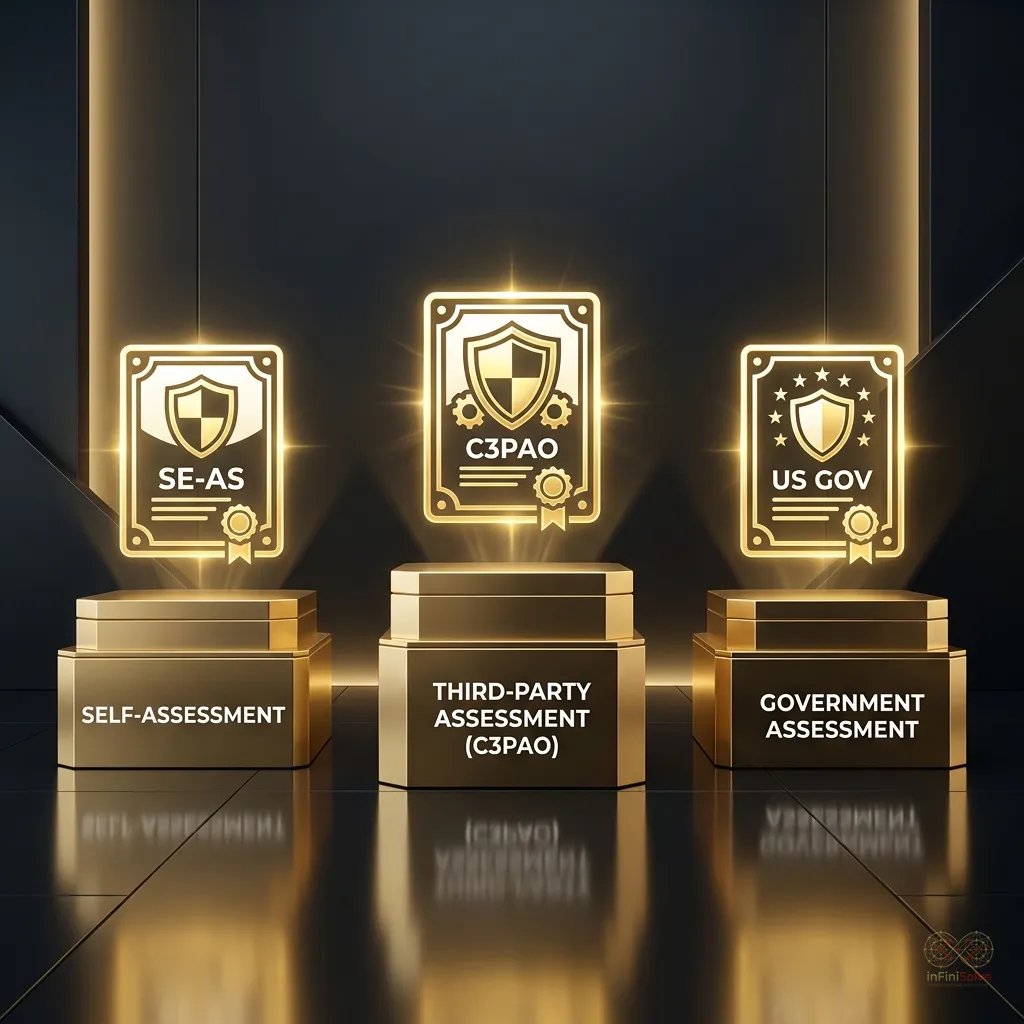
Under CMMC 2.0, the assessment framework is split based on the criticality of the information you handle:
Self-Assessment (For Select Non-Prioritized Programs) For contracts involving less-critical CUI, contractors may be permitted to perform an annual self-assessment against the 110 controls and upload their resulting score to the Supplier Performance Risk System (SPRS). Crucially, a C-level executive of your company must sign an annual, legally binding attestation of compliance. Falsifying this attestation falls directly under the False Claims Act and can result in severe financial penalties or debarment.
Third-Party Assessment (For Most Prioritized Programs) For the vast majority of contracts involving critical national security information, contractors must undergo an intensive, multi-day assessment conducted by an accredited Certified Third-Party Assessment Organization (C3PAO).
The C3PAO will rigorously evaluate your documented evidence (policies), conduct deep-dive interviews with your IT and operations teams to ensure they understand the policies, and issue a formal certification valid for three years.
You cannot bluff a C3PAO. If a written policy states that you review audit logs weekly, the auditor will ask for timestamped proof of those reviews from the last six months. If you say you use MFA, they will literally watch you log in to verify it is active.
A Step-by-Step Road to Audit Readiness
Small businesses often panic at the perceived cost and complexity of CMMC compliance. However, by taking a strategic, methodical approach, you can achieve audit readiness without bankrupting your operations:
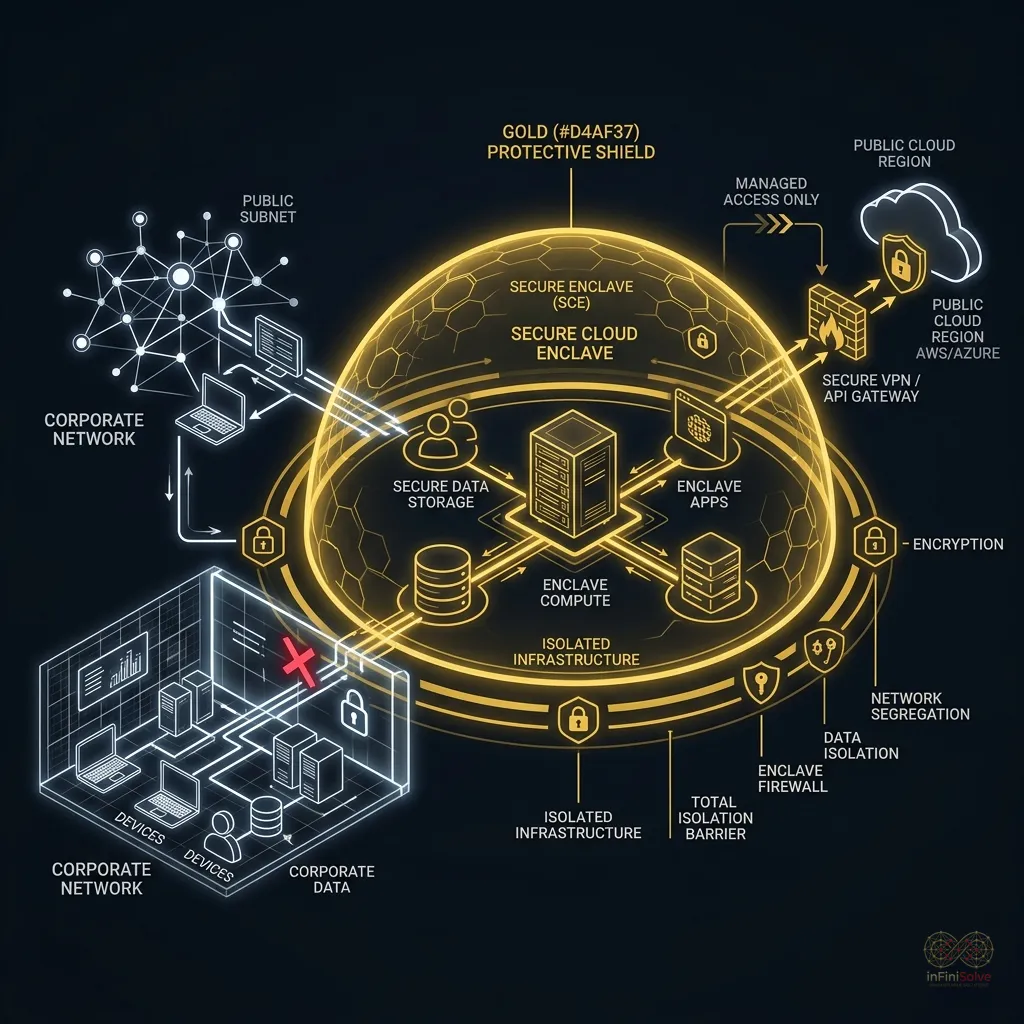
Step 1: Limit the Scope (Enclaving) Do not try to make your entire, sprawling corporate network CMMC compliant. Identify exactly where CUI enters your company, who absolutely needs to touch it, and where it goes. Segment those users and data into a secure "enclave."
For small businesses, leveraging a compliant cloud environment like Microsoft 365 GCC High or a secure Virtual Desktop Infrastructure (VDI) allows you to completely isolate CUI from your primary commercial network. This dramatically reduces the scope of your audit, limits the number of devices in scope, and slashes your compliance costs.
Step 2: Conduct a Brutally Honest Gap Analysis Compare your current IT practices against the 110 controls. Identify which controls are Fully Met, Partially Met, or Not Met. Do not mark a control as "Met" if it is not heavily documented in an overarching written policy.

Frequently Asked Questions (FAQ)
Q: How long does a CMMC Level 2 certification remain valid? A: Once achieved, a CMMC Level 2 certification is valid for three years. However, contractors are still required to submit an annual self-assessment signed by a senior company official to verify continuous compliance.
Q: Can I use commercial Microsoft 365 or Google Workspace for CMMC Level 2? A: Generally, no. Standard commercial tenants do not meet the strict incident reporting requirements of DFARS 7012 (specifically the requirement to provide forensic images to the DoD), nor do they guarantee that data resides exclusively on U.S. soil. Most defense contractors must migrate to Microsoft 365 GCC (Government Community Cloud) or GCC High.
Q: How much does a C3PAO audit cost? A: The cost varies wildly depending on the size of your organization and the scope of your enclave. For a small business with a tightly defined enclave, the audit itself typically costs between $30,000 and $50,000, not including the remediation costs required to get ready for the audit.
Q: What is a C3PAO? A: A Certified Third-Party Assessment Organization. They are private cybersecurity auditing firms that have been rigorously vetted and accredited by the Cyber AB (the accreditation body for CMMC) to conduct official assessments on behalf of the DoD.
Q: Can I pass CMMC if I use foreign nationals or offshore IT support? A: If you handle CUI, absolutely not. Access to CUI is strictly limited to "U.S. Persons." Your IT Managed Service Provider (MSP) must be entirely U.S.-based, and their personnel must be U.S. citizens to access systems within your compliance boundary.
Related InfiniSolve Insights
To further enhance your federal contracting strategy, explore these highly authoritative resources from the InfiniSolve knowledge base: - Zero Trust Architecture: A Practical Implementation Guide for DoD Subcontractors - Government IT Modernization Best Practices: Legacy System Migration - How to Write a Winning Capability Statement for Government Contracts
Ready to dominate your sector?
Partner with InfiniSolve to architect a digital footprint that wins contracts and captures market share.
Schedule Strategy Session