
Davis-Bacon Act vs. Service Contract Act: Navigating Federal Prevailing Wage Determinations
Federal labor compliance is one of the most perilous regulatory minefields in government contracting. When competing for or executing federal contracts, businesses routinely encounter statutory prevailing wage mandates governed by the Department of Labor (U.S. Department of Labor Wage and Hour Division). The two foundational statutes governing federal labor rates are the Davis-Bacon Act (DBA) and the McNamara-O'Hara Service Contract Act (SCA).

While both statutes exist to prevent contractors from undercutting local prevailing wages on taxpayer-funded projects, their legal triggers, covered labor categories, fringe benefit calculations, and administrative reporting requirements are fundamentally different. Misclassifying an employee, underpaying Health and Welfare (H&W) fringes, or failing to submit weekly certified payroll reports can result in contract withholding, severe back-pay assessments, three-year statutory debarment, and False Claims Act liability. This comprehensive guide breaks down the critical distinctions, hybrid contract pitfalls, and compliance protocols necessary to safeguard your business.
- --
Table of Contents 1. Core Statutory Frameworks: Davis-Bacon Act vs. Service Contract Act 2. Statutory Thresholds, Applicability, and Covered Classifications 3. The Anatomy of a Wage Determination (WD) on SAM.gov 4. Fringe Benefits and Health & Welfare (H&W) Compliance 5. Certified Payroll Reporting (Form WH-347) vs. SCA Recordkeeping 6. Navigating Hybrid Contracts: When Construction Meets Service 7. Department of Labor (DOL) Audits and De-Escalation Protocols 8. Frequently Asked Questions (FAQ) 9. Related InfiniSolve Insights
- --
Core Statutory Frameworks: Davis-Bacon Act vs. Service Contract Act
To properly structure pricing volumes and direct labor burden rates, contractors must understand the distinct legislative intents behind each statute:
- The Davis-Bacon Act (40 U.S.C. § 3141 et seq.): Enacted in 1931, the DBA applies to federal and federally assisted contracts in excess of $2,000 for the construction, alteration, or repair of public buildings or public works. The act mandates that contractors pay mechanics and laborers not less than the locally prevailing wages and fringe benefits for corresponding work on similar projects in the area.
- The Service Contract Act (41 U.S.C. § 6701 et seq.): Enacted in 1965, the SCA applies to every contract entered into by the United States or the District of Columbia in excess of $2,500, the principal purpose of which is to furnish services in the United States through the use of service employees. It covers routine operations, maintenance, security, IT support, logistics, and clerical services.
Under FAR Part 22 (Application of Labor Laws to Government Acquisitions), Contracting Officers are required to incorporate the appropriate wage determination clauses directly into solicitations: FAR 52.222-6 for Davis-Bacon and FAR 52.222-41 for Service Contract Labor Standards.
- --
Statutory Thresholds, Applicability, and Covered Classifications
Distinguishing between a "mechanic or laborer" under the DBA and a "service employee" under the SCA is essential when building staffing models:
| Compliance Dimension | Davis-Bacon Act (DBA) | Service Contract Act (SCA) |
|---|---|---|
| :--- | :--- | :--- |
| Primary Statutory Trigger | Construction, alteration, or repair of public buildings/works | Contracts whose principal purpose is to furnish services |
| Contract Value Threshold | $2,000 | $2,500 |
| Covered Workers | Laborers and mechanics on the physical site of work | Service employees (non-exempt under FLSA) |
| Exempt Classifications | Executive, administrative, and professional personnel | Bona fide executive, administrative, and professional staff (29 CFR Part 541) |
| Payroll Frequency | Weekly certified payroll (WH-347) submission mandatory | Standard employer pay cycle; certified submission only upon audit |
| Overtime Requirement | Covered under Contract Work Hours and Safety Standards Act (CWHSSA) | Covered under Fair Labor Standards Act (FLSA) / CWHSSA |
- --
The Anatomy of a Wage Determination (WD) on SAM.gov
Prevailing wage rates are not static; they are published and updated by the Department of Labor on SAM.gov Wage Determinations.
Contractors must meticulously analyze the specific WD incorporated into Section J of their solicitation:
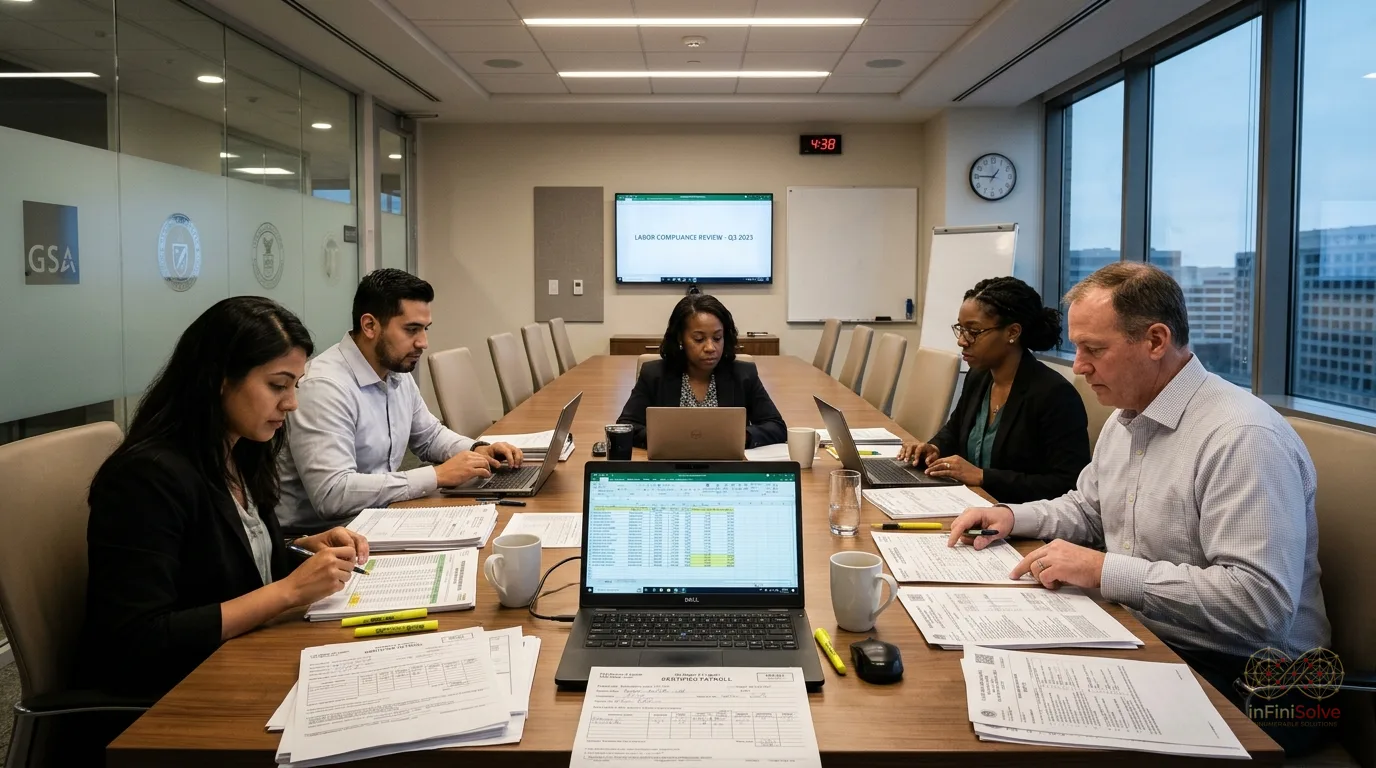
- DBA Wage Determinations: Identified by county and construction type (Building, Heavy, Highway, or Residential). DBA rates are established through DOL regional wage surveys or collective bargaining agreements (CBAs). DBA rates often differentiate between union-dominant counties and open-shop survey averages.
- SCA Wage Determinations: Identified by standard metropolitan statistical area (SMSA) or county. SCA determinations publish standardized minimum hourly wages across hundreds of specific job classification codes (e.g., General Clerk, Computer Operator, Security Guard, Janitor) derived from the DOL SCA Directory of Occupations.
- The Conformance Process (SF-1444): If a required labor classification is missing from an SCA or DBA wage determination, the contractor cannot arbitrarily invent a rate. Under FAR 22.1019, the contractor must submit an official Standard Form 1444 (Request for Authorization of Additional Classification and Rate) to the Contracting Officer within 30 days of employee placement, who then forwards it to the DOL for formal approval.
- --
Fringe Benefits and Health & Welfare (H&W) Compliance
The single most common source of Department of Labor audit violations involves the calculation and payment of fringe benefits.
- SCA Health and Welfare (H&W) Rates: SCA wage determinations specify a mandatory, fixed per-hour Health and Welfare cash equivalent or bona fide fringe rate (e.g., $5.36 per hour, or $4.93 per hour for contractors offering paid sick leave under Executive Order 13706). This amount must be paid on all hours paid (up to 40 hours per week), including paid vacations and holidays. Contractors can satisfy this mandate by either paying cash in lieu of benefits or contributing directly into "bona fide" health, life, retirement, or disability plans.
- DBA Fringe Benefits: Unlike the fixed flat-rate SCA H&W, Davis-Bacon fringe benefits are itemized line-by-line per trade classification (e.g., Electrician: $34.50 basic hourly rate + $14.20 fringe). Under the DBA, fringe benefit obligations must be paid for all hours worked, including overtime hours (although the overtime premium applies only to the basic hourly rate, not the fringe).
- The Bona Fide Plan Requirement: To qualify for fringe credit under either statute, contributions must be made to an irrevocable trust or third-party trustee. Contractors cannot simply claim credits for mandatory employer taxes such as Social Security (FICA), workers' compensation, or state unemployment taxes.
- --
Certified Payroll Reporting (Form WH-347) vs. SCA Recordkeeping
The compliance burden under the Davis-Bacon Act includes stringent, continuous government reporting that does not exist under standard commercial or SCA service contracts:
- Weekly Certified Payroll (Form WH-347): Under the Copeland "Anti-Kickback" Act and DBA regulations, every prime contractor and subcontractor on a DBA-covered project must submit an official certified payroll report weekly to the Contracting Officer. The report must contain every worker's name, craft classification, hours worked daily, gross wages, itemized deductions, and net pay.
- Statement of Compliance: Page 2 of Form WH-347 requires an executive officer to sign an explicit statement of compliance under penalty of perjury, certifying that wages paid are not less than the applicable wage determination and that no rebates or kickbacks were exacted.
- SCA Recordkeeping Requirements: In contrast, SCA contractors are not required to submit weekly certified payrolls to the Contracting Officer. However, under 29 CFR 4.6, contractors must maintain detailed records (hours worked, actual rates paid, fringe benefit documentation) for at least three years, and make them available upon demand during a DOL Wage and Hour Division audit.
Contractors expanding their federal footprint should align labor accounting with their broader capture models; explore our guide on FAR Part 13 Simplified Acquisition: How Small Contractors Win 72-Hour Quick-Quotes.
- --
Navigating Hybrid Contracts: When Construction Meets Service
One of the most complex challenges occurs on federal "hybrid" or mixed-scope contracts. For example, a prime contract for base operations support (SCA service) may include maintenance work orders to renovate a barracks bathroom or repave an access road (DBA construction).
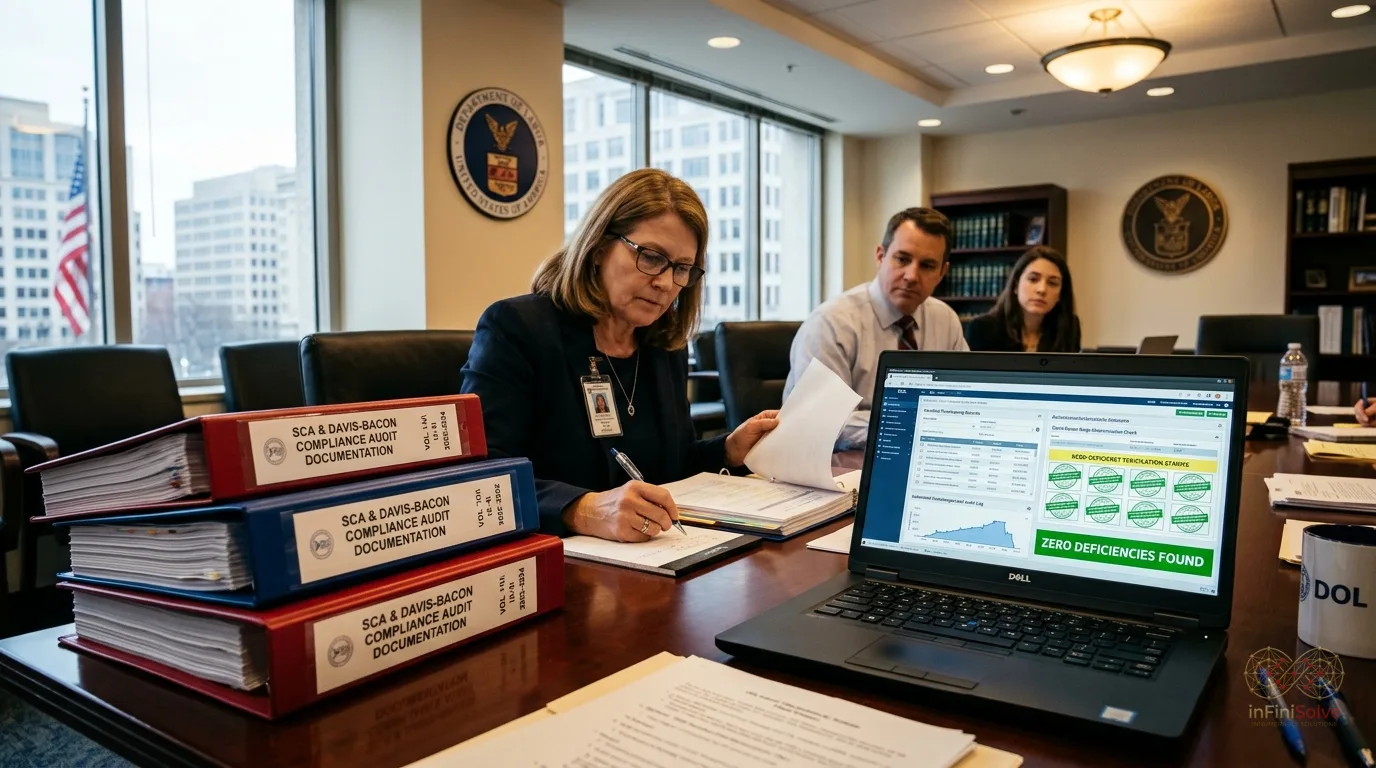
- The Substantial and Segregable Test: Under 29 CFR § 4.116, if a service contract involves construction, alteration, or repair work that is "substantial and segregable," the construction portion is strictly governed by the Davis-Bacon Act, while the ongoing service and maintenance portions remain governed by the Service Contract Act.
- Dual-Classification Timekeeping: Workers performing both service tasks and construction repairs during the same workweek must maintain rigorous, minute-by-minute timecards. If an employee spends 20 hours as an SCA Maintenance Mechanic and 20 hours as a DBA Carpenter, the contractor must compensate each block of hours under the corresponding wage determination. If time is comingled without segregated records, the DOL will legally enforce the higher construction wage rate across all 40 hours.
- --
Department of Labor (DOL) Audits and De-Escalation Protocols
The Wage and Hour Division (WHD) of the Department of Labor possesses sweeping investigative authority. DOL investigators routinely conduct unannounced on-site worker interviews, subpoena payroll logs, and inspect timekeeping software.
If your firm receives notice of a DOL Wage and Hour investigation: 1. Designate a Single Point of Contact: Prohibit uncoordinated employee communications with auditors. Appoint your Chief Compliance Officer or legal counsel as the primary liaison. 2. Perform an Immediate Internal Audit: Before producing records, cross-reference all certified payroll submissions against bank direct deposit logs and third-party benefit trust statements to identify potential rounding or fringe discrepancies. 3. Correct Administrative Errors Promptly: If unintentional underpayments occurred due to misclassification, calculate back wages immediately, issue corrective payments to affected employees, and provide verifiable proof of remediation to the investigator. 4. Defend Subcontractor Flow-Downs: Prime contractors are legally liable for subcontractor labor violations. Ensure all subcontracts contain mandatory FAR flow-down clauses and certified payroll withholding remedies. When managing contract risks or responding to government notices, review our master playbook on Responding to Government Cure Notices: How Contractors Remediate Deficiencies.
- --
Frequently Asked Questions (FAQ)
Q1: What is the main difference between the Davis-Bacon Act and the Service Contract Act? A1: The Davis-Bacon Act applies to federal construction, alteration, and repair contracts over $2,000, requiring weekly certified payroll. The Service Contract Act applies to federal service and support contracts over $2,500, requiring prevailing wages and Health & Welfare fringe benefits.
Q2: What happens if an employee performs both SCA and DBA work in the same week? A2: Contractors must maintain segregated timekeeping records. The employee must be paid the respective prevailing wage rate for hours spent under each statute. If hours are comingled, the contractor must pay the higher construction rate for all hours.
Q3: Can fringe benefits under the Service Contract Act be paid in cash? A3: Yes. Under the SCA, employers can satisfy the Health and Welfare requirement either by contributing to bona fide benefit plans or by paying the full equivalent hourly fringe amount directly on the employee's regular paycheck.
Q4: How frequently must Davis-Bacon certified payrolls be submitted? A4: Davis-Bacon regulations mandate that contractors and subcontractors submit Form WH-347 certified payroll reports to the federal Contracting Officer on a weekly basis, within seven days following the close of the pay period.
Q5: What is the penalty for violating federal prevailing wage laws? A5: Penalties include mandatory contract payment withholding, back-pay assessments with interest, contract termination for default, False Claims Act civil penalties, and a mandatory three-year government-wide debarment.
Q6: How do contractors handle missing job classifications in a wage determination? A6: Contractors must initiate a formal conformance request using Standard Form 1444 (SF-1444) through the Contracting Officer, proposing a wage rate bearing a reasonable relationship to existing classifications for DOL approval.
- --
Related InfiniSolve Insights - Responding to Government Cure Notices: How Contractors Remediate Deficiencies - FAR Part 13 Simplified Acquisition: How Small Contractors Win 72-Hour Quick-Quotes - Federal Contract Terminations: T4C vs. T4D Explained - State and Local Billboard Procurement: Winning High-Margin Outdoor Media Contracts
Ready to dominate your sector?
Partner with InfiniSolve to architect a digital footprint that wins contracts and captures market share.
Schedule Strategy Session