How to Write a Winning Capability Statement for Government Contracts
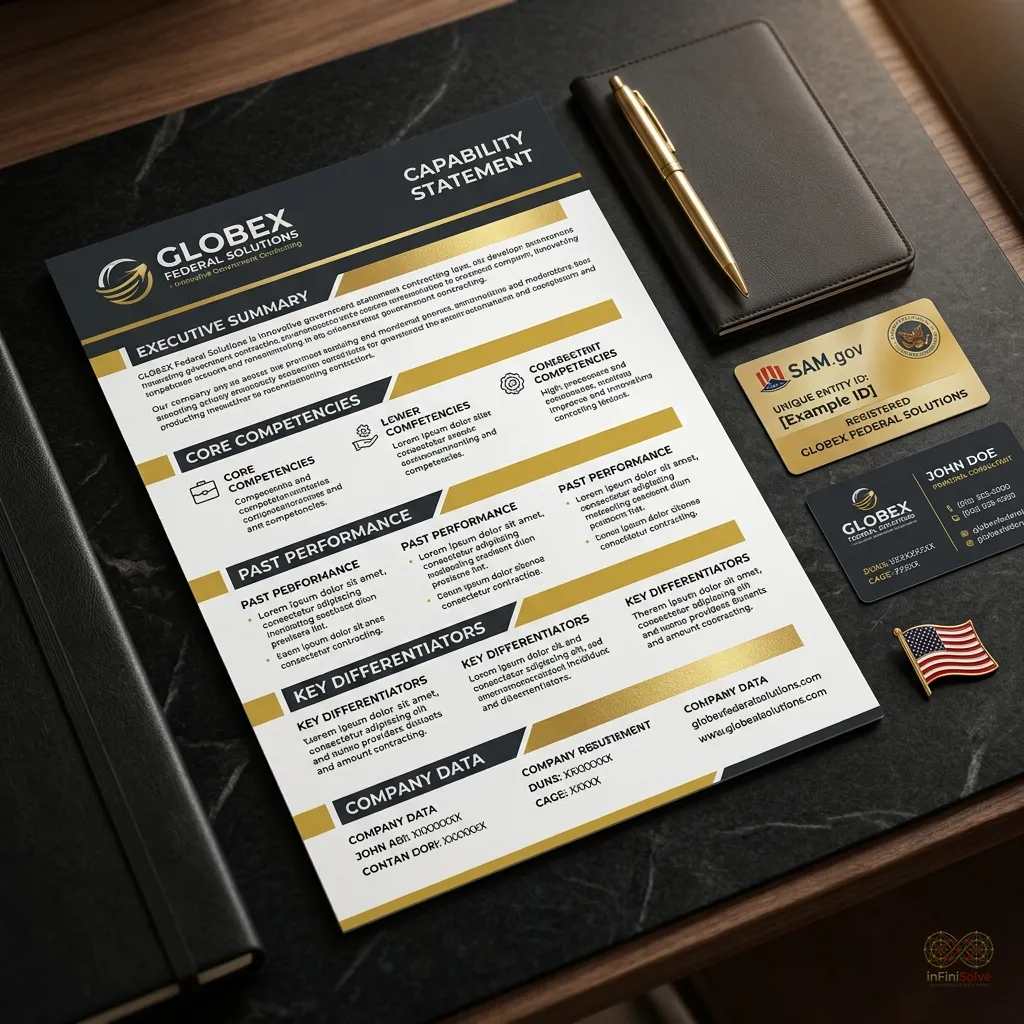
A capability statement is your company's resume for government work. Under FAR Part 10, contracting officers are explicitly required to conduct market research before issuing solicitations, and your capability statement is often the very first document they review.
If your firm doesn't have a modern, properly formatted capability statement—or if you're still using a generic Word document from 2015—you are actively losing contracts to competitors who simply look more professional. In the federal sector, perception is reality. A poorly formatted document signals to a contracting officer that you lack the attention to detail required to manage a highly regulated federal contract. Furthermore, with the rapid acceleration of federal IT modernization and procurement standards in 2026, the expectations for how a capability statement is designed, delivered, and structured have dramatically evolved.
In this definitive, comprehensive guide, we break down the exact 6-section framework that passes the critical 10-second contracting officer test, the catastrophic mistakes to avoid, and the modern digital distribution strategy you need to get your document into the hands of the right federal buyers, prime contractors, and Small Business Liaison Officers.
Table of Contents
- 01.Why Every Government Contractor Needs a Capability Statement
- 02.The 10-Second Test: First Impressions Matter
- 03.The 6 Essential Sections of a Winning Capability Statement
- 04.Digital vs. Print: The Omnichannel Distribution Strategy
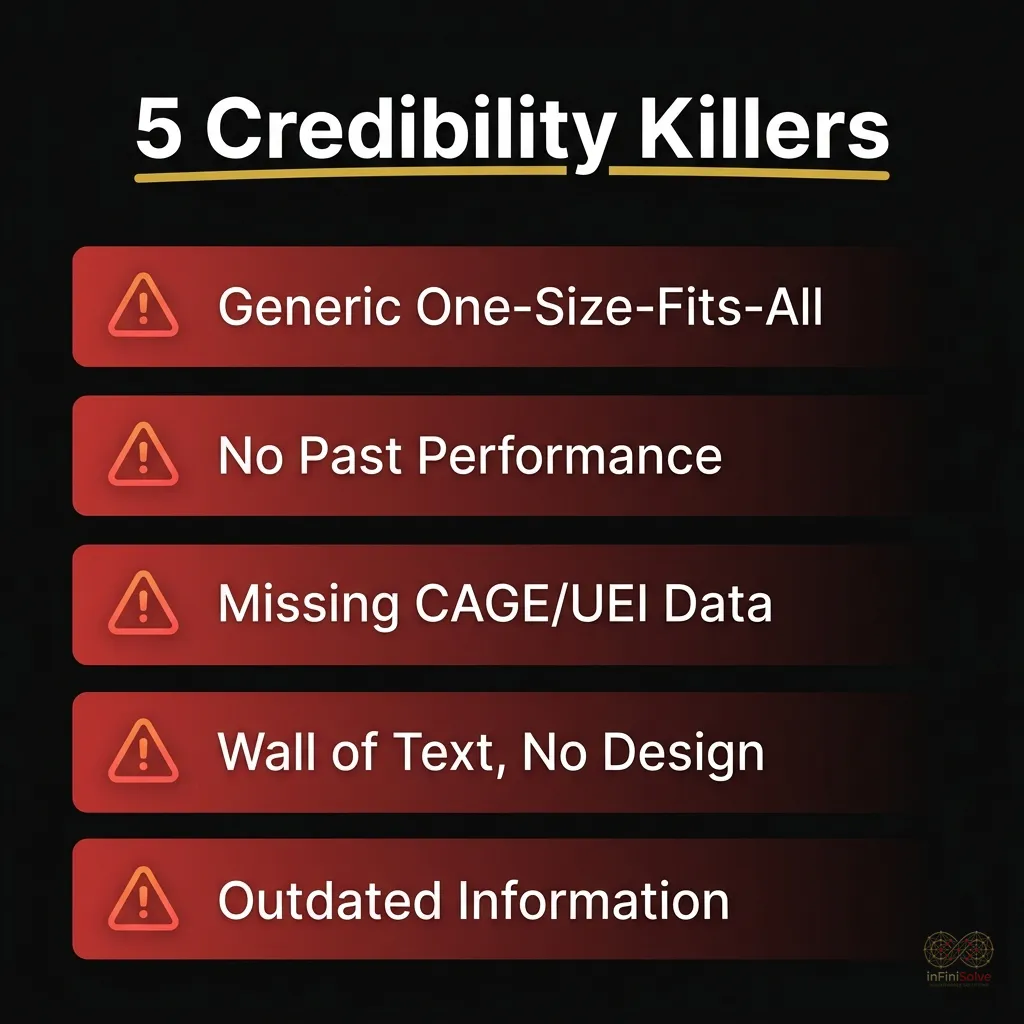
- 05.5 Credibility Killers to Avoid
- 06.Your Next Steps for Immediate Execution
- 07.Frequently Asked Questions (FAQ)
- 08.Related InfiniSolve Insights
Why Every Government Contractor Needs a Capability Statement
A capability statement is not just a marketing brochure; it is a fundamental, heavily relied upon procurement tool. Different players in the GovCon ecosystem use your capability statement for different purposes, and you must understand these audiences to tailor your messaging effectively.
- Contracting Officers (COs): COs use your statement during the early market research phase. When they post a Sources Sought notice on SAM.gov, they are evaluating whether there are enough qualified small businesses (like 8(a), HUBZone, or SDVOSB firms) to justify setting the contract aside rather than opening it to full and open competition (the "Rule of Two"). If your statement clearly demonstrates that you can perform the work, you are actively helping the CO justify setting the contract aside for small businesses like yours.
- Small Business Liaison Officers (SBLOs): Large prime contractors (like Lockheed Martin, Booz Allen Hamilton, or Leidos) are mandated by the federal government to subcontract a certain percentage of their massive awards to small businesses. SBLOs at these prime contracting firms use your capability statement to evaluate if your firm is a viable, low-risk subcontracting partner that can help them meet their small business subcontracting goals without jeopardizing the mission.
- Agency Program Managers: While COs handle the business and legal aspects of the contract, the technical evaluators (Program Managers or Technical Leads) use your capability statement to verify that your firm possesses the deep, specific technical competencies required for their upcoming requirements. They are looking for domain expertise, not just a list of generic services.
If you want to play in the highly lucrative federal space, possessing an impeccable capability statement is entirely non-negotiable.
The 10-Second Test: First Impressions Matter
Contracting officers and federal buyers are incredibly busy. They receive hundreds of emails, cold calls, and capability statements every single week. When a CO opens your document, you have exactly 10 seconds to communicate three critical pieces of information:
- What do you do? (Your hyper-specific Core Competencies, mapped to federal language).
- Are you legally eligible to do business? (Your CAGE Code, UEI, and active SAM.gov status).
- Have you successfully done this before? (Your Past Performance with federal, state, or commercial entities).
If they cannot answer those three fundamental questions within 10 seconds of scanning your document, it goes straight into the trash. The key to passing the 10-second test is extreme formatting discipline. Your capability statement must be concise, scannable, and heavily utilize bullet points. It must fit on one single page (front and back is acceptable, but a single-sided one-pager is heavily preferred by procurement officials).
The 6 Essential Sections of a Winning Capability Statement
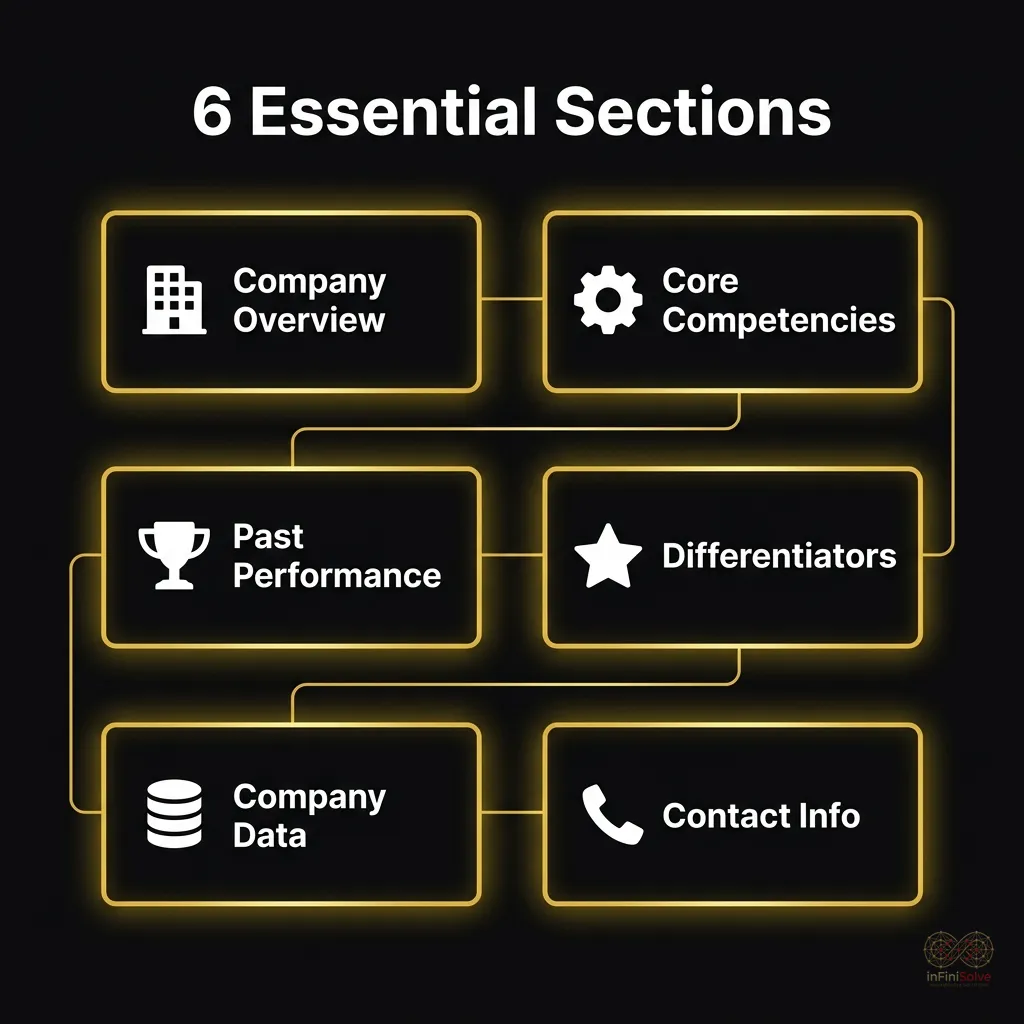
A winning capability statement follows a strict, standardized structure. This is not the time to be overly creative with abstract layouts or non-traditional formats. Procurement officials expect to see information organized logically. The following six sections form the absolute core of a compliant and compelling capability statement:
1. Company Overview & Core Narrative This is your 2-3 sentence elevator pitch located at the very top of the document, immediately under your logo and company name. Do not write a novel about your company's history or how you were founded in a garage. Federal buyers do not care about your backstory; they care about how you can reduce their risk and solve their immediate problems.
State exactly who you are, your socio-economic status, and your core value proposition in clear, unambiguous language.
*Example of a Bad Overview:* "We are a great IT company that puts the customer first. We have been in business for 10 years, we love technology, and our team is highly dedicated to providing excellent customer service." (This is generic commercial fluff).
*Example of a Winning Overview:* "InfiniSolve LLC is an SBA-certified 8(a) Small Disadvantaged Business (SDB) specializing in zero-trust cybersecurity infrastructure and AI-driven automation for the Department of Defense. We engineer resilient cloud architectures that accelerate deployment timelines by 30% while ensuring strict CMMC 2.0 and NIST SP 800-171 compliance."
2. Core Competencies List your primary capabilities as concise bullet points. Do not be vague. Tie your competencies directly to your NAICS codes and federal terminology.
Instead of writing "IT Services," write "Cloud Migration & Architecture (NAICS 541512)." Instead of "Consulting," write "CMMC Level 2 Compliance Readiness & Auditing." This demonstrates that you speak the government's language.
Use columns to organize your competencies so they are easily scannable. Limit yourself to 5-8 bullet points. If you list 20 wildly different competencies (e.g., Software Development, Janitorial Services, and Landscaping), the CO will immediately assume you are a "jack of all trades, master of none" and discard your statement as too risky.
3. Past Performance (The Trust Engine) This is arguably the most critical section of the entire document. Past performance is what separates serious federal contractors from amateurs. You must prove that you can execute the work you are claiming to specialize in.
List 2 to 4 specific contracts you have completed that are highly relevant to your target agency. For each entry, include: - Client/Agency Name: e.g., U.S. Air Force - Lackland AFB - Project Title: e.g., Secure Network Modernization & Zero-Trust Implementation - Contract Number: Including this proves it was a real federal contract. - Period of Performance: e.g., 2023 - 2025 - Brief Description of Value Delivered: 1-2 sentences highlighting a measurable outcome, not just a list of tasks. (e.g., "Successfully migrated 5,000 users to a secure GovCloud environment, achieving zero downtime and reducing operational costs by 15%").
If you do not have federal past performance yet, that is perfectly fine. List relevant commercial work or state/local government contracts, but explicitly state that they are commercial past performance so you do not mislead the reader.
4. Differentiators Why should the government choose you over the 10,000 other IT firms registered in SAM.gov? What is your competitive moat?
Differentiators are not "we work hard," "we have great customer service," or "we are passionate." Those are expectations, not differentiators. True federal differentiators include: - Specific facility clearances (e.g., Top Secret Facility Clearance). - Proprietary technology, patented frameworks, or exclusive vendor partnerships. - Specialized, highly sought-after workforce certifications (e.g., CISSP, PMP, AWS Certified Solutions Architect, Certified Ethical Hacker). - Unusually fast mobilization times, unique geographic positioning near military installations, or highly specialized linguist capabilities.
5. Company Data (The Transactional Block) This section is purely transactional, but if it is missing, a contracting officer literally cannot process your firm for an award. This block is usually placed in a sidebar or at the bottom of the page in high contrast.
You must meticulously include: - CAGE Code: Your 5-character Commercial and Government Entity code. - UEI: Your 12-character Unique Entity Identifier (which permanently replaced the DUNS number). - NAICS Codes: List your Primary NAICS code first, clearly labeled, followed by 3-4 highly relevant secondary codes. - PSC/FSC Codes: Product and Service Codes relevant to your offerings. - Socio-Economic Certifications: e.g., SBA 8(a), HUBZone, SDVOSB, WOSB. - Active Contract Vehicles: e.g., GSA MAS, Seaport-NxG, OASIS+, CIO-SP4.
Frequently Asked Questions (FAQ)
Q: Does my capability statement really need to be just one page? A: Yes. While a two-sided document (one sheet, front and back) is acceptable for firms with extensive past performance, the industry standard and overwhelming preference of federal buyers is a single, concise page. If you cannot distill your value into one page, you lack focus.
Q: Can I use commercial past performance on my government capability statement? A: Absolutely, especially if you are a new entrant to the federal market. However, you must clearly label it as "Commercial Past Performance" and ensure the scope and complexity of the commercial work is relevant to the federal contracts you are pursuing.
Q: Should I include pricing or rates on my capability statement? A: No. A capability statement is for market research and initial introductions, not pricing negotiations. Pricing is highly dependent on the specific requirements of a solicitation and should only be provided in a formal proposal or quote.
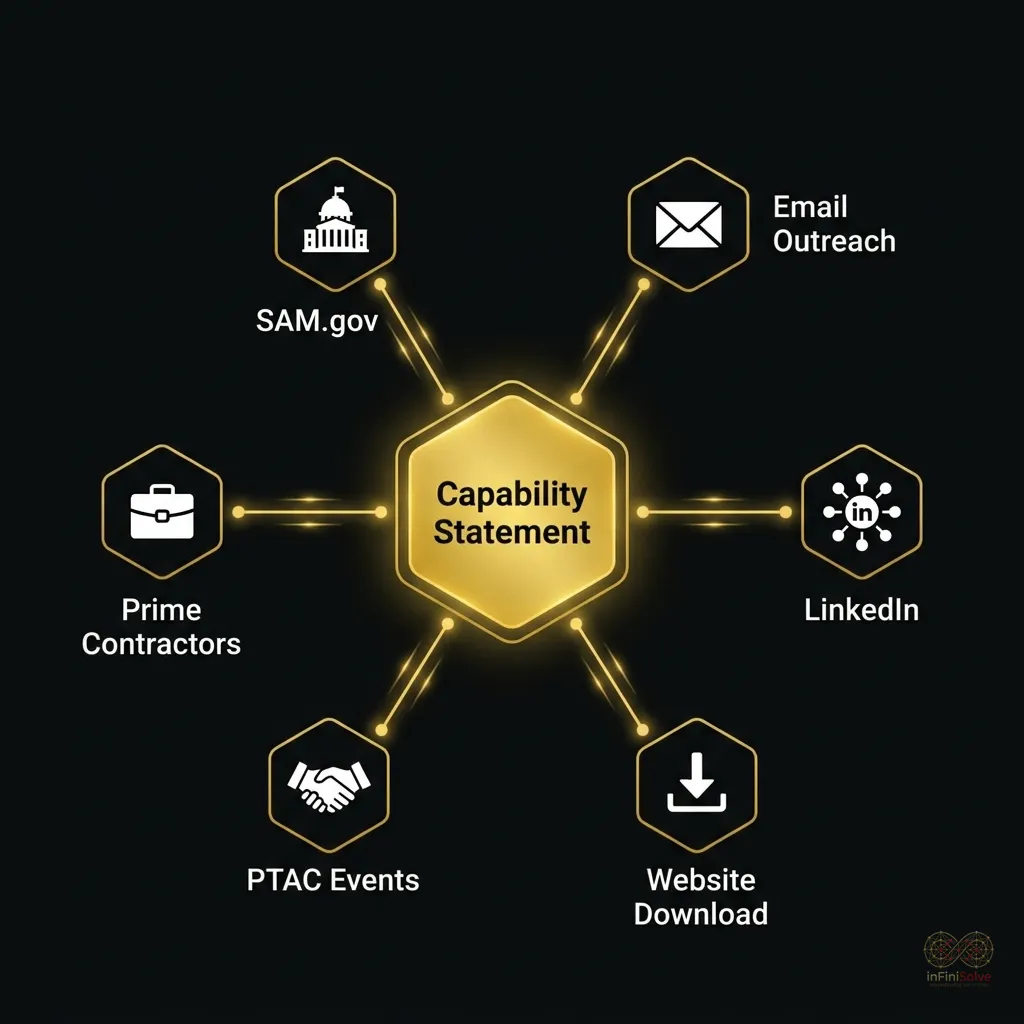
Q: How do I know if my capability statement is actually working? A: If you are sending it out as a PDF attachment, tracking is difficult. We highly recommend utilizing a Digital Capability Statement hosted on your website. This allows you to use analytics tools (like Google Analytics 4) to track exactly how many federal buyers clicked the link, how long they stayed on the page, and which sections they read.
Related InfiniSolve Insights
To further enhance your federal contracting strategy, explore these highly authoritative resources from the InfiniSolve knowledge base: - Winning Federal Contracts with a High-Converting Digital Capability Statement - B2B GovCon Outreach Strategy: Scaling Beyond SAM.gov - Why SEO is Critical for GovCon: Dominating the Digital Landscape
Ready to dominate your sector?
Partner with InfiniSolve to architect a digital footprint that wins contracts and captures market share.
Schedule Strategy Session