The Buy American Act: 2026 Domestic Sourcing Rules for Federal Contractors

# The Buy American Act: 2026 Domestic Sourcing Rules for Federal Contractors
As the geopolitical landscape shifts and the federal government aggressively prioritizes domestic manufacturing resilience, the Buy American Act (BAA) has evolved into one of the most critical compliance frameworks in the entire GovCon ecosystem. Originally enacted in 1933 during the Great Depression, the BAA was designed to create and preserve American jobs by mandating that the U.S. government purchase domestically produced materials and manufactured goods.
However, in the modern era of hyper-complex, globally distributed supply chains, verifying compliance is no longer a simple checkbox exercise. Recent Executive Orders, specifically the aggressive tightening of domestic content thresholds under the Biden Administration's "Made in America" initiatives, have completely transformed the regulatory landscape. For federal contractors in 2026, failing to meticulously trace, calculate, and document the origin of every component in their end products can result in catastrophic bid rejections, devastating False Claims Act (FCA) lawsuits, and permanent debarment from federal contracting.
This comprehensive 2026 compliance guide will decode the dense regulatory text of the FAR, outline the specific testing mechanisms required to verify domestic origin, and provide strategic workarounds for when domestic sourcing is impossible.
Table of Contents
- --
1. Understanding the Core Mandate of the Buy American Act
At its foundation, the Buy American Act applies to all federal supply contracts and construction contracts that exceed the micro-purchase threshold (currently $10,000 for standard acquisitions). The core mandate is elegantly simple in theory, but incredibly complex in practice: The federal government must give preferential treatment to "domestic end products" and "domestic construction materials" over foreign equivalents during the procurement evaluation process.
The Pricing Penalty It is a common misconception that the BAA outright bans the federal government from purchasing foreign goods. This is false. Instead, the BAA implements a pricing penalty during the evaluation phase.
If a Contracting Officer receives competing bids containing both domestic and foreign end products, they must apply an evaluation factor to the foreign bid to determine if the domestic bid is "unreasonable" in price. For civilian agencies, this penalty is typically 20% (or 30% if the domestic offer is from a small business). For Department of Defense (DoD) acquisitions under the DFARS, the penalty is a staggering 50%. This means a foreign product must be massively cheaper than its domestic counterpart to win the award.
- --
2. The Two-Part Test for Manufactured Goods
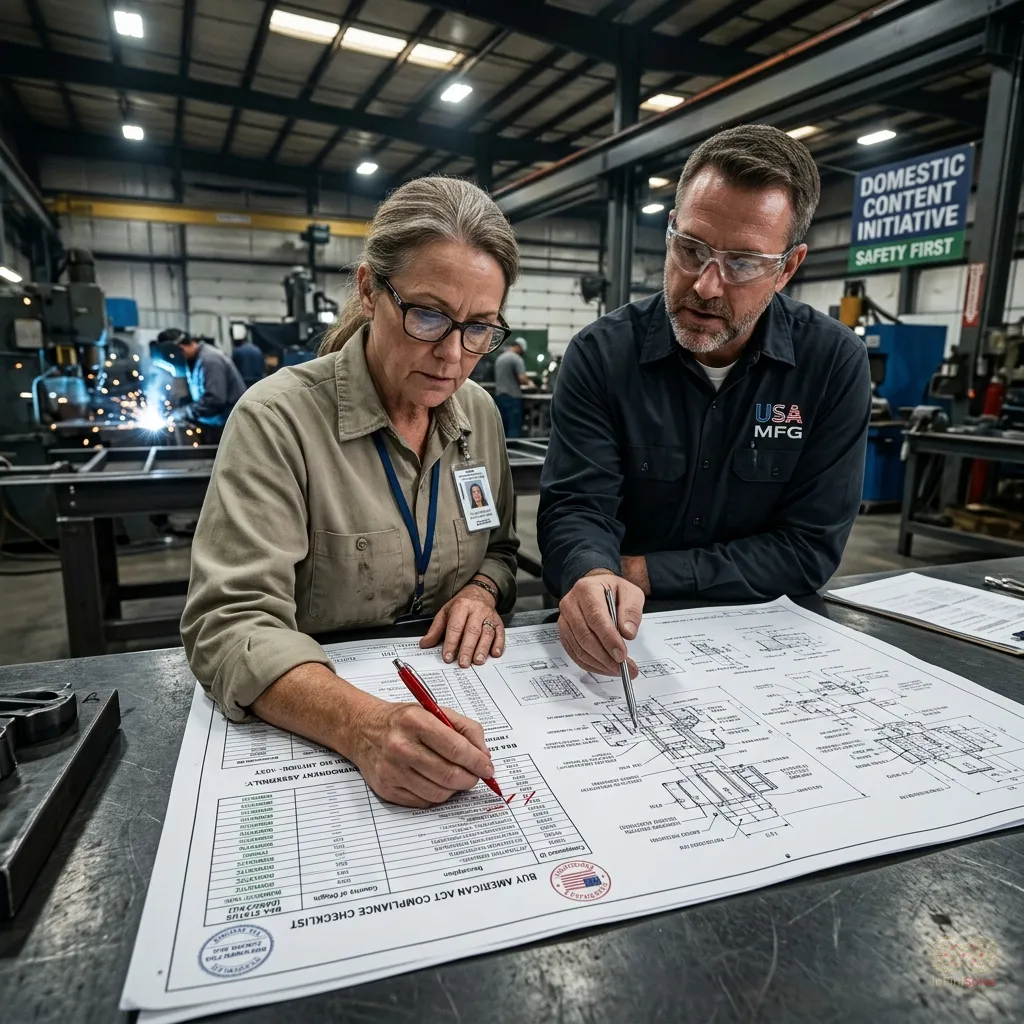
To qualify as a "domestic end product" and avoid the massive pricing penalties, a manufactured good must successfully pass a strict, two-part test outlined in FAR Part 25.
Test 1: Manufactured in the United States The first prong of the test requires that the final manufacturing process must take place physically within the United States. While the FAR does not explicitly define "manufacturing," the Government Accountability Office (GAO) and the Court of Federal Claims have established through case law that the process must fundamentally alter the components into a distinct new entity. Simple assembly, packaging, or superficial modifications (like painting) of foreign parts within the U.S. do not satisfy this requirement.
Test 2: The Component Test The second prong is the quantitative hurdle that traps most contractors. The cost of the product's domestically mined, produced, or manufactured components must exceed a specific percentage of the total cost of all components. This requires contractors to trace their supply chains deeply, identifying the country of origin and exact cost basis for every screw, microchip, and housing unit in their final product.
For unmanufactured goods (like raw agricultural products or mined ores), the test is simpler: the good must be mined or produced in the United States.
- --
3. The Escalating Domestic Content Thresholds
Prior to 2021, the domestic content threshold for the component test was a relatively achievable 50%. However, Executive Order 14005 initiated a phased escalation of these requirements to aggressively force supply chains back to American soil.
As of 2026, contractors must adhere to the following rigid schedule:
* 2022 to 2023: 60% Domestic Content * 2024 to 2028: 65% Domestic Content * 2029 and Beyond: 75% Domestic Content
This means that if you are submitting a bid in 2026, 65% of the total component cost of your manufactured end product must originate in the United States to qualify for the BAA preference. If you fail to meet this 65% threshold, your product is legally classified as a "foreign end product" and will be hit with the 20%, 30%, or 50% price evaluation penalty, virtually guaranteeing you will lose the contract.
The Fallback Provision Recognizing that these aggressive thresholds might result in supply shortages, the government implemented a temporary "fallback" provision. Until 2030, if an agency cannot find a domestic end product meeting the new 65% threshold (or if the price is unreasonable), they can accept products meeting the old 55% threshold. However, contractors should not rely on this fallback, as it requires explicit Contracting Officer approval and deep market research justification.

- --
4. Trade Agreements Act (TAA) Exemptions
The Buy American Act does not operate in a vacuum. It interacts heavily with international treaties and trade policy, most notably through the Trade Agreements Act (TAA).
When the value of a federal contract exceeds specific monetary thresholds (which fluctuate based on the specific trade agreement, but often hover around $183,000 for standard supply contracts), the TAA takes precedence over the Buy American Act.
Designated Countries Under the TAA, the President has the authority to waive the Buy American Act for products originating in "Designated Countries." These are countries that have reciprocal free trade agreements with the United States (like the WTO Government Procurement Agreement, or specific bilateral agreements like the USMCA).
If a contract is TAA-applicable, products that are "wholly the growth, product, or manufacture" of a Designated Country, or have been "substantially transformed" in a Designated Country, are evaluated equally with domestic products. They suffer zero price penalties.
The Danger of Non-Designated Countries The critical caveat of the TAA is that while it opens the door to allied nations (like Japan, the UK, or Mexico), it aggressively slams the door on non-designated countries. Under a TAA-applicable contract, the government is legally prohibited from purchasing products originating in non-designated countries (such as China, India, or Russia) entirely, regardless of price.
Navigating the intersection of the BAA and the TAA is incredibly complex. For a deeper understanding of how these compliance matrices affect overall growth strategy, review our definitive guides on CMMC Level 2 Compliance and Government IT Modernization.
- --
5. The Waiver Process: When Domestic Sourcing is Impossible
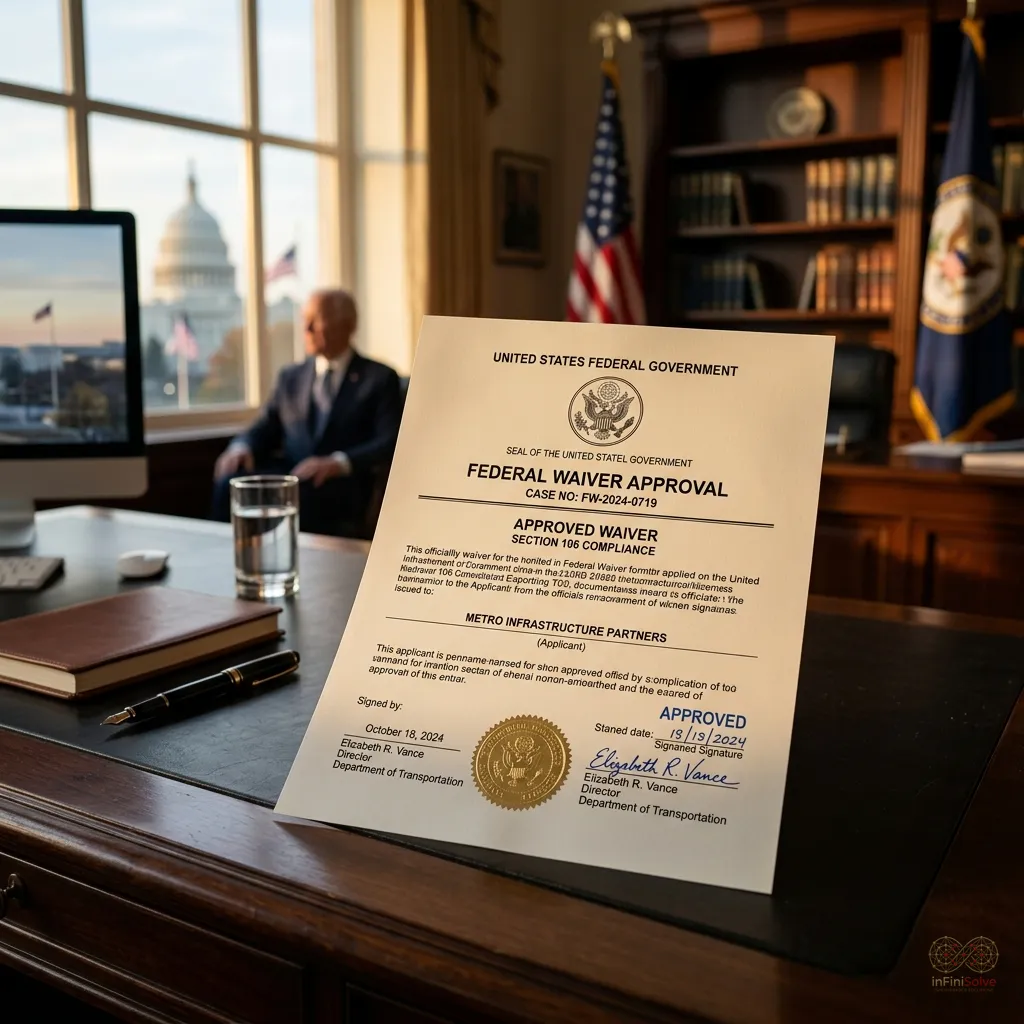
There are legitimate scenarios where a domestic product simply does not exist, or the domestic options are so prohibitively expensive that it would constitute highway robbery against the American taxpayer. In these instances, the FAR allows for specific statutory waivers to the Buy American Act.

Commercial Information Technology One of the most widely utilized exemptions is the blanket waiver for Commercial Information Technology (IT). Recognizing that the vast majority of the global microchip and hardware supply chain resides overseas, the FAR exempts the purchase of commercial IT from the Buy American Act entirely. This prevents the federal government's tech infrastructure from grinding to a halt due to sourcing restrictions.
Nonavailability Waivers If an agency requires a specific material or product that is not mined, produced, or manufactured in the United States in sufficient and reasonably available commercial quantities (of satisfactory quality), the Contracting Officer can issue a "Nonavailability Waiver." The FAR actually maintains a pre-approved list of nonavailable articles (ranging from specific raw minerals to vanilla beans), but contractors can also request individual class waivers during the solicitation process.
Unreasonable Cost Waivers As mentioned earlier, if the domestic product triggers the evaluation penalty (e.g., the domestic product is more than 20% more expensive than the foreign option), the Contracting Officer determines the domestic price is "unreasonable" and can legally award the contract to the foreign supplier.
To ensure your pricing models are optimized to compete against both foreign and domestic competitors, explore our strategic guide on LPTA vs. Best Value Tradeoffs.
- --
6. Frequently Asked Questions (FAQ)
Q: Do Commercial Off-The-Shelf (COTS) items have to pass the Buy American Act component test? A: No. In a massive regulatory relief effort, the FAR waives the component test (the 65% threshold) for COTS items. A COTS item only needs to pass the first test: it must be manufactured in the United States.
Q: What is the difference between the Buy American Act (BAA) and the Buy America Act? A: While they sound identical, they are different statutes. The "Buy American Act" (BAA) applies to direct purchases by the federal government. The "Buy America Act" applies to federal grants given to state and local governments for transit and highway infrastructure projects (like the Federal Transit Administration). The rules and thresholds for both are completely different.
Q: How does the government verify my BAA compliance? A: Primarily through self-certification. When you submit a proposal on SAM.gov or directly to an agency, you must sign a legally binding certificate declaring your products as domestic or foreign. However, if a competitor protests your award, or the Inspector General audits your contract, you must produce the exhaustive supply chain cost documentation to prove your certification was accurate.
Q: If my software is coded in the United States, does it pass the Buy American Act? A: Software is generally classified as Commercial Information Technology, which is broadly exempt from the BAA. However, if the software is inextricably tied to a hardware system, the hardware must still be evaluated under standard BAA or TAA rules.
FAQ
Related InfiniSolve Insights
Ready to dominate your sector?
Partner with InfiniSolve to architect a digital footprint that wins contracts and captures market share.
Schedule Strategy Session