How to Leverage SBA 8(a) Sole Source Contracts for Explosive Growth

The Small Business Administration (SBA) 8(a) Business Development Program is widely considered to be the most powerful, legally sanctioned wealth-creation vehicle in the entire federal government ecosystem. For small, socially and economically disadvantaged businesses, successfully achieving 8(a) certification is a monumental, genuinely life-changing milestone.
However, a critical, frequently fatal mistake made by thousands of newly certified 8(a) firms is assuming that the certification itself is a guarantee of revenue. It is not. The certification is merely a hunting license; it is entirely up to you to track the game and pull the trigger.
The true, asymmetric advantage of the 8(a) program does not lie in competing against other small businesses for set-aside contracts. The true advantage lies in the massive power of the sole source contract. Under the powerful statutory authority of FAR Subpart 19.8, federal agencies are legally granted the ability to bypass the grueling, highly expensive, and months-long competitive bidding process and award a contract *directly* to your 8(a) certified firm without any competition whatsoever.
For 2026, the sole source thresholds are massively advantageous: $4.5 million for goods and services, and $7.5 million for manufacturing contracts. For Native Hawaiian Organizations (NHOs), Alaska Native Corporations (ANCs), and federally recognized Indian Tribes, these thresholds can be significantly higher—or completely uncapped with the proper Department of Defense (DoD) justifications.
If your firm is 8(a) certified but you are still sitting back, relying entirely on passively scrolling through public SAM.gov solicitations to find highly competitive work, you are completely missing the strategic point of the program. In this comprehensive guide, we detail exactly how to proactively engineer sole source awards, navigate the SBA's complex regulatory hurdles, and heavily leverage the strict 9-year 8(a) program window for explosive, uncompetitive growth.
Table of Contents
- 01.The Anatomy of an 8(a) Sole Source Award
- 02.Step 1: Mapping the Target Agency and the Money
- 03.Step 2: The Proactive Capability Briefing
- 04.Step 3: Leveraging Joint Ventures and the MPP
- 05.Step 4: Navigating the SBA Adverse Impact Rule
- 06.Maximizing the Strict 9-Year Window
- 07.Frequently Asked Questions (FAQ)
- 08.Related InfiniSolve Insights
The Anatomy of an 8(a) Sole Source Award
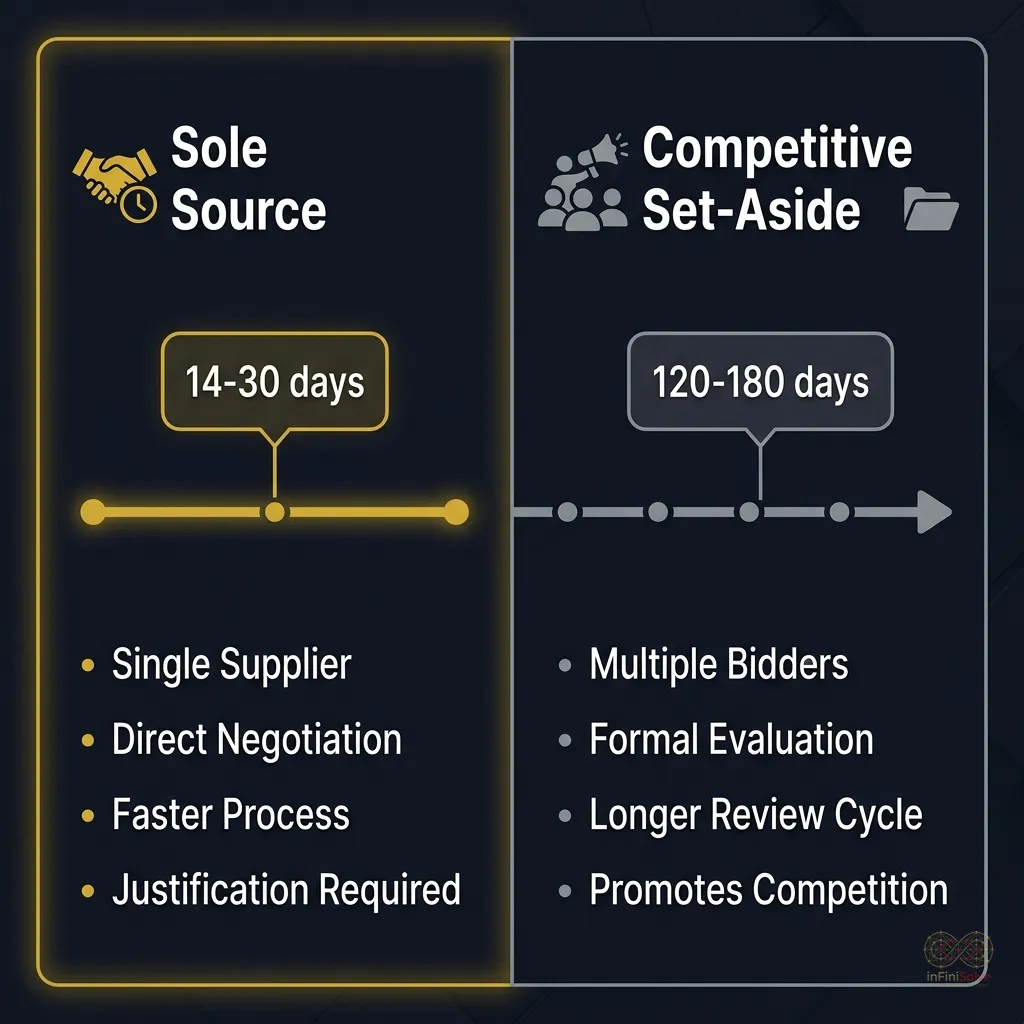
A common, fatal misconception among new 8(a) firms is that the government will simply look up their name in a database, call them randomly on a Tuesday, and casually offer them a $4 million contract because they hold the certification. This absolutely never happens. Sole source contracts are not passively received like lottery winnings; they are actively and strategically engineered through relentless business development and hyper-targeted relationship building.
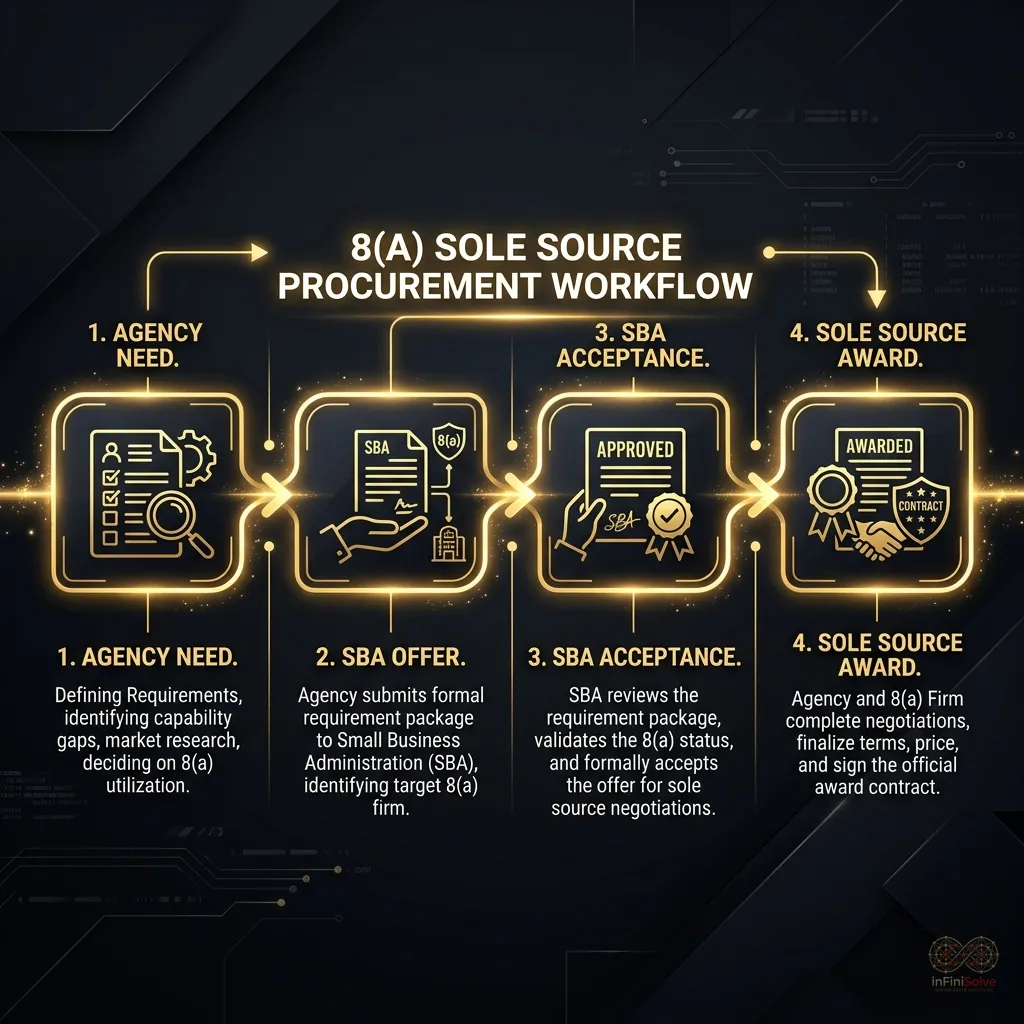
The sole source process is highly collaborative between you, the agency, and the SBA, typically following this exact lifecycle:
- The Contractor Identifies a Need: Through aggressive market research or direct agency conversations, you discover that an agency has an upcoming requirement, an expiring contract, or an urgent pain point that is currently unaddressed.
- The Capability Briefing: You proactively secure a meeting with the agency's Small Business Professional (SBP), Program Manager, or Contracting Officer (CO) and pitch your highly specific, risk-reducing solution.
- The Sole Source Pitch: During the briefing, you explicitly remind the CO that they can bypass the typical 12-to-18-month competitive acquisition cycle by issuing a direct award to your firm via the 8(a) program, saving them immense administrative burden and eliminating protest risk.
- The Offering Letter: The convinced CO drafts a formal "offering letter" (detailing the scope of work and estimated value) and sends it directly to your assigned SBA Business Opportunity Specialist (BOS).
- SBA Acceptance: The SBA reviews the offering letter to ensure it meets the strict legal monetary thresholds, verifies your firm's NAICS code eligibility, and checks for adverse impact rules. They then formally accept the requirement on your behalf.
- Negotiation and Award: The agency issues a Request for Proposal (RFP) specifically to you. You submit your proposal, negotiate pricing directly with the agency (with absolute zero competition), and the contract is awarded.
The entire process, from offering letter to award, can often be completed in less than 30 to 45 days. For federal contracting officers who are constantly drowning in procurement backlog and actively fear bid protests, the sheer speed and legal simplicity of an 8(a) sole source is incredibly attractive.
Step 1: Mapping the Target Agency and the Money
You cannot effectively pitch a sole source contract if you fundamentally don't know who has the funding, who has the authority to spend it, and who is actively struggling to meet their small business goals. Your very first step is to aggressively map your target agency using data-driven intelligence.
Utilize free federal databases like the Federal Procurement Data System (FPDS) and USAspending.gov to deeply analyze historical spending patterns. You are looking for three highly specific signals: - NAICS Alignment: Agencies that consistently buy massive volumes of the specific services defined by your primary NAICS codes. - Sole Source History: Agencies that have a highly proven track record of utilizing the 8(a) sole source vehicle (not all agencies use it equally; the DoD and HHS are massive users, while others are vastly more hesitant). - Goal Deficiencies: Agencies that are currently failing to meet their mandated 5% Small Disadvantaged Business (SDB) utilization goals, as published annually by the SBA. Agencies failing their scorecards are genuinely desperate to award 8(a) sole sources to catch up before the end of the fiscal year.
Once you identify a high-probability target agency, you must find and directly contact the Small Business Professional (SBP). Their entire federal job description is to help the agency meet its small business goals and act as a powerful bridge between small businesses and the contracting officers. They are your ultimate internal champions.
Step 2: The Proactive Capability Briefing
Do not wait for an agency to officially publish a Sources Sought notice or a Request for Information (RFI). By the time a requirement officially hits SAM.gov, the acquisition strategy (whether it will be set aside or competed) has almost always already been decided behind closed doors.
You must secure a capability briefing *before* the requirement is formally defined. When you pitch to the SBP or Contracting Officer, your digital and print materials must be completely flawless.
Your sole source pitch must relentlessly focus on two things: 1. Technical Superiority: How your specific technical solution, unique past performance, and specialized staff solve their exact pain point better than the incumbent contractor or a generic commercial off-the-shelf (COTS) solution. 2. Acquisition Speed and Risk Reduction: "We understand this mission-critical cloud migration needs to happen by Q3 to avoid a security breach. Because we are an 8(a) certified firm in good standing, you can sole-source this requirement directly to us under FAR 19.8, saving your office 8-12 months of procurement lead time and entirely eliminating the risk of a bid protest delaying your mission."
You are not just selling your IT, construction, or consulting services; you are actively selling the *speed, convenience, and safety* of the 8(a) contracting vehicle.
Step 3: Leveraging Joint Ventures and the MPP
What happens if an agency absolutely loves your firm and your technical approach, but the upcoming requirement is a $25 million enterprise IT modernization project—far exceeding the $4.5 million sole source threshold? Are you completely locked out?
No. This is where the SBA Mentor-Protégé Program (MPP) becomes your ultimate, unstoppable growth multiplier. Under the MPP, you (the 8(a) protégé) can form a legally binding Joint Venture (JV) with a massive, highly established prime contractor (the mentor, such as a multi-billion dollar systems integrator).
The incredibly powerful aspect of this program is that the JV takes on the 8(a) socio-economic status of the protégé. This allows the large prime contractor to legally access massive 8(a) set-aside contracts they are normally strictly excluded from. In return, you (the protégé) gain access to the prime's massive past performance portfolio, top-tier facility clearances, immense lines of credit, and deep technical resources to easily execute the work.
Frequently Asked Questions (FAQ)
Q: What is the dollar threshold for 8(a) sole-source contracts? A: In 2026, the sole-source threshold for 8(a) contracts is $4.5 million for standard services and manufacturing, and $7.0 million for manufacturing. Sole-source awards above these limits require formal justification and approval (J&A) by the contracting agency.
Q: If an agency issues an offering letter, is the SBA required to accept it? A: No. The SBA reviews every offering letter and will reject it if they determine the requirement violates the adverse impact rule, or if the firm's NAICS codes do not align with the statement of work.
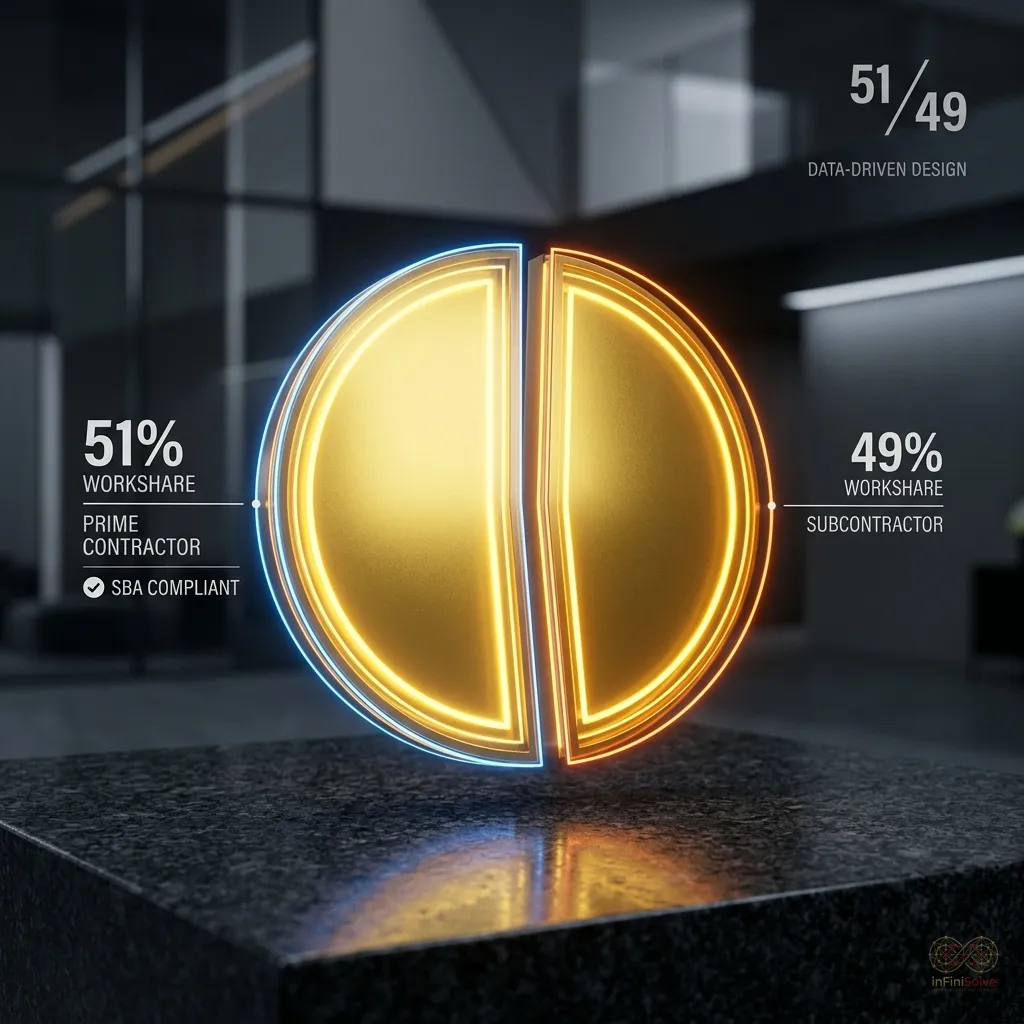
Q: Can I use an 8(a) sole source contract to buy commercial software? A: Yes, but only if your firm is performing at least 50% of the value of the services (or meeting the Non-Manufacturer Rule requirements for supplies). You cannot act as a simple pass-through to sell Microsoft licenses without adding significant value.
Q: Does a sole source contract mean I don't have to write a proposal? A: You still have to write a proposal, but it is vastly simpler. You are not competing against other firms, so your proposal is simply proving to the Contracting Officer that your technical approach is sound and your pricing is fair and reasonable based on historical data.
Q: What happens to my 8(a) contracts when I graduate from the program? A: You are generally allowed to finish the base and option years of the contracts you won while in the program, but you cannot receive new 8(a) sole source awards after graduation.
Related InfiniSolve Insights
To further enhance your federal contracting strategy, explore these highly authoritative resources from the InfiniSolve knowledge base: - GovCon Teaming Agreements & Joint Ventures: The Ultimate Growth Strategy - The Buy American Act & Domestic Sourcing: A Guide for 2026 GovCon Compliance - How to Win Federal Contracts With Zero Past Performance
Ready to dominate your sector?
Partner with InfiniSolve to architect a digital footprint that wins contracts and captures market share.
Schedule Strategy Session